Showing posts with label Genetics. Show all posts
Wednesday, January 29, 2014
Puzzling Question in Bacterial Immune System Answered (Berkeley Lab)
A central question has been answered regarding a protein that plays an essential role in the bacterial immune system and is fast becoming a valuable tool for genetic engineering. A team of researchers with the Lawrence Berkeley National Laboratory (Berkeley Lab) and the University of California (UC) Berkeley have determined how the bacterial enzyme known as Cas9, guided by RNA, is able to identify and degrade foreign DNA during viral infections, as well as induce site-specific genetic changes in animal and plant cells. Through a combination of single-molecule imaging and bulk biochemical experiments, the research team has shown that the genome-editing ability of Cas9 is made possible by the presence of short DNA sequences known as “PAM,” for protospacer adjacent motif. [Read Full Article]
Friday, January 24, 2014
New genes spring from non-coding DNA (UC Davis)
"Where do new genes come from?" is a long-standing question in genetics and evolutionary biology. A new study from researchers at the University of California, Davis, published Jan. 23 in Science Express, shows that new genes are created from non-coding DNA more rapidly than expected. [Read Full Article]
Wednesday, January 15, 2014
A Missing Genetic Link in Human Evolution (Quanta Magazine)
About 8 million to 12 million years ago, the ancestor of great apes,
including humans, underwent a dramatic genetic change. Small pieces of
DNA replicated and spread across their resident chromosomes like
dandelions across a lawn. But as these “dandelion seeds” dispersed, they
carried some grass and daisy seeds — additional segments of DNA — along
for the ride. This unusual pattern, repeated in different parts of the genome, is found only in great apes — bonobos, chimpanzees, gorillas and humans. [Read Full Article]
Monday, January 13, 2014
Genetically identical bacteria can behave in radically different ways (UW Health Sciences)
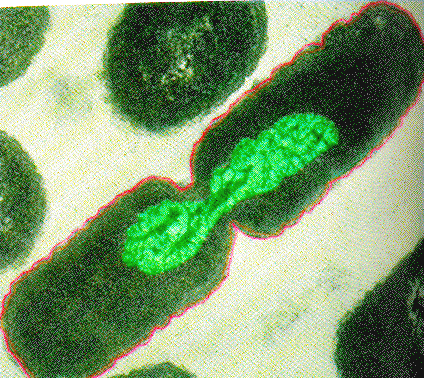
Although a population of bacteria may be genetically identical,
individual bacteria within that population can act in radically
different ways
This phenomenon is crucial in the bacteria’s struggle for survival. The more diversity a population of bacteria has, the more likely it will contain individuals able to take advantage of a new opportunity or overcome a new threat, including the threat posed by an antibiotic. [Read Full Article]
Monday, January 6, 2014
Bacterium Reverses Autismlike Behavior in Mice (Scientific American)
Doses of a human gut microbe helped to reverse behavioral problems in mice with autism-like symptoms, researchers report today in Cell. The treatment also reduced gastrointestinal problems in the animals that were similar to those that often accompany autism in humans.
The work builds on previous research by Paul Patterson, a neurobiologist at the California Institute of Technology (Caltech) in Pasadena. In 2012, he and his team created mice with autism-like symptoms by injecting a chemical that mimics viral infection into pregnant mice; those animals then bore offspring that were less sociable and more anxious than wild-type animals. [Read Full Article]
Wednesday, December 18, 2013
Bacteria Can Integrate Degraded DNA (The Scientist)
Bacteria are known to take in long fragments of DNA, discarded by the dead cells of other organisms, and incorporate them into their own genomes. Results published today (November 18) in Proceedings of the National Academy of Sciences show that bacteria can also integrate short and damaged stretches of DNA, even 43,000-year-old fragments extracted from a woolly mammoth bone.
Short, degraded DNA is abundant in the environment, “and if that can be used for transformation or mutagenesis, that suggests it has a much larger evolution-driving role than previously ever realized,” said Hank Seifert, a microbiologist at Northwestern University who was not involved in the study. [Read Full Article]
Monday, December 16, 2013
Fixing Protein Folding (The Scientist)
Though many diseases arise because the protein product of a gene does
not function correctly, others occur because misfolded proteins get
stuck in the endoplasmic reticulum or are degraded before arriving at
the site where they should act in the cell. [Read Full Article]
Subscribe to:
Posts (Atom)


